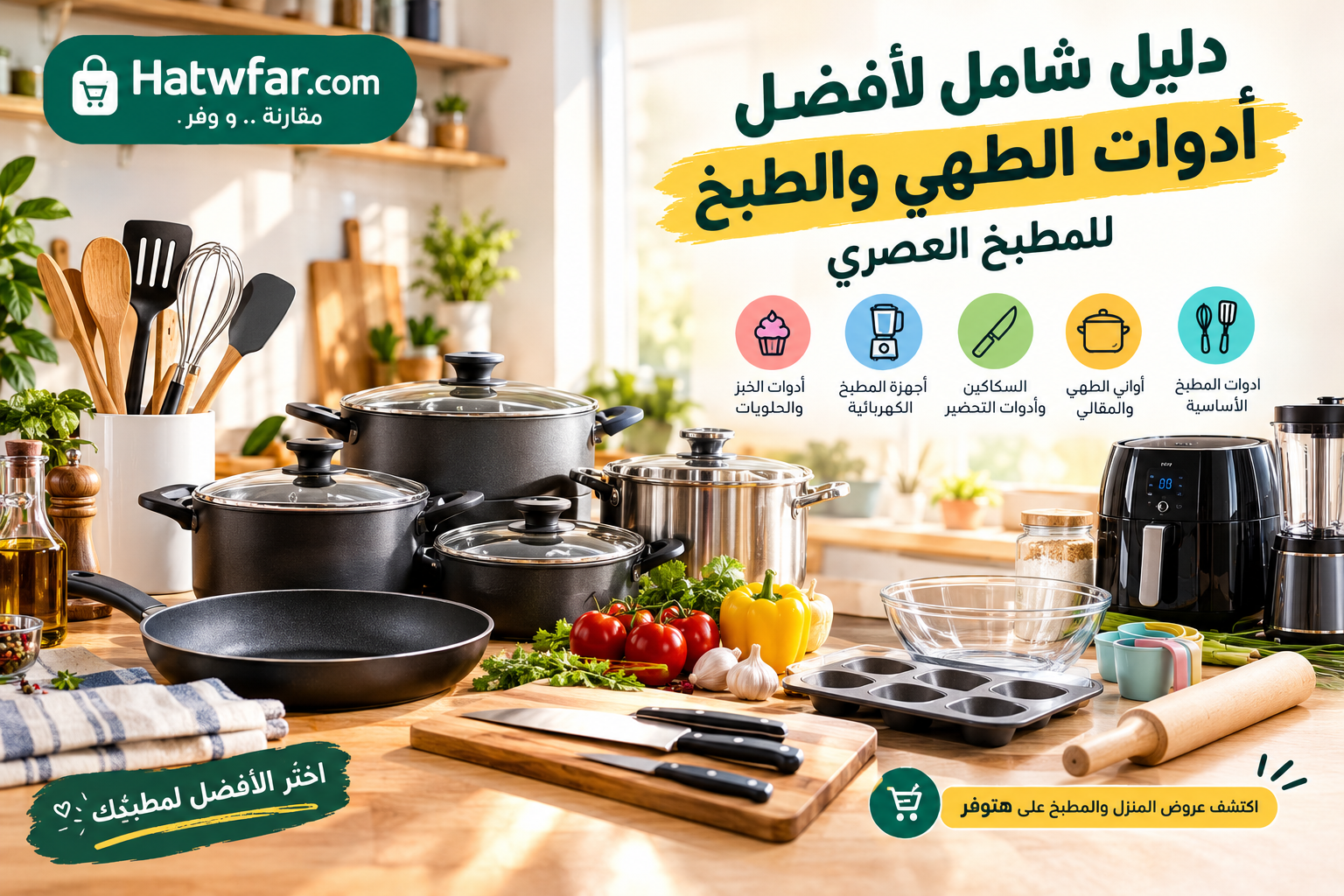
Hatwfar Home & Kitchen Guide
Best Cooking and Kitchen Tools in 2026: The Complete Guide to Cookware, Utensils, and Kitchen Essentials
A practical kitchen starts with the right cooking tools. From pots and pans to kitchen knives, food preparation utensils, storage solutions, and electrical appliances, choosing suitable kitchen essentials can make everyday cooking easier and help you organize your space more effectively. However, with so many materials, designs, brands, and prices available, choosing the right products requires thoughtful research.
In this comprehensive guide from Hatwfar, we explore essential cooking tools, explain the differences between common cookware materials, and share practical tips for choosing kitchen appliances, organizing supplies, and comparing products before buying.
Explore home and kitchen deals on Hatwfar to discover available products and review your options before making a purchase.
Essential Cooking and Kitchen Tools for Every Home
Every kitchen has different needs, but a practical collection of essential cooking tools can make everyday meal preparation easier. If you are setting up a new kitchen, begin with items you will use regularly before investing in specialized equipment.
1. Pots and Cooking Pans in Different Sizes
Pots and pans are among the most important kitchen essentials. They are used to prepare rice, soups, pasta, vegetables, sauces, and many everyday meals. Having several useful sizes allows you to choose cookware that matches the amount of food you are preparing.
Before buying a pot, inspect its base, handles, lid, and overall build quality. Check the manufacturer's care instructions and confirm that the cookware is compatible with your stove.
2. Versatile Frying Pans
Frying pans are useful for preparing eggs, vegetables, meat, fish, and various sautéed dishes. A smaller pan may be suitable for individual portions, while a larger pan can be more practical for family meals. Choose the size and surface according to your cooking habits.
If you choose a nonstick pan, review the manufacturer's instructions for temperature limits, cleaning, and suitable utensils. Avoid scratching the cooking surface and follow the recommended care routine.
3. Lids, Ladles, and Cooking Utensils
Suitable lids and cooking utensils make everyday meal preparation more convenient. Spatulas, ladles, whisks, and stirring spoons should be comfortable to hold, easy to clean, and appropriate for the cookware you use.
4. Measuring Cups, Spoons, and Digital Scales
Measuring tools are particularly useful for baking and recipes that require consistent quantities. Measuring cups, standard measuring spoons, and digital kitchen scales can help you control ingredients and reproduce recipes more reliably.
5. Mixing Bowls and Colanders
Mixing bowls are useful for preparing salads, sauces, and dough, while colanders help rinse and drain ingredients. Choose sizes that match your cooking habits, and consider nesting bowls if storage space is limited.
Pots, Pans, and Cookware Sets: What Should You Buy?
A complete cookware set can be convenient, but it is not necessarily the best choice for every household. Consider the number of people you cook for, the meals you prepare most often, and the available storage space before selecting a set.
Choosing a Cookware Set
Compare the number of pieces, pot sizes, materials, lid quality, and handle construction. Do not judge a set by its piece count alone. A smaller set with useful sizes may be more practical than a larger set containing items you rarely use.
Choosing Everyday Frying Pans
Select a frying pan based on the foods you prepare and your preferred cooking method. Consider the surface, size, handle design, and care requirements. Always confirm that the pan is suitable for your stove.
Pressure Cookers
Pressure cookers can reduce the preparation time of certain foods. Before purchasing one, review its capacity, safety mechanisms, cleaning requirements, warranty, and availability of replacement parts. Follow the manufacturer's instructions for safe operation.
Oven Dishes and Baking Pans
If you regularly prepare oven meals or baked goods, choose cookware specifically designed for the intended temperature and use. Check the dimensions, material, and manufacturer instructions before placing any dish in an oven.
Choosing the Right Cookware Material
Cookware materials influence heat distribution, everyday handling, cleaning, and maintenance. No single material is ideal for every cooking task, so consider your budget, cooking style, and care preferences.
Stainless Steel Cookware
Stainless steel is a popular choice for pots and kitchen equipment because of its durability and practical maintenance requirements. Review the quality of the construction, base, and handles, and check compatibility with your cooking surface.
Nonstick Cookware
Nonstick surfaces can make certain foods easier to cook and cookware easier to clean. Performance and lifespan depend on the product's quality and how it is used. Follow the manufacturer's temperature, cleaning, and utensil recommendations.
Cast Iron Cookware
Cast iron can retain heat effectively and may suit cooking methods that benefit from steady heat. However, it can be heavy and may require specific maintenance depending on its finish and construction.
Aluminum Cookware
Aluminum cookware is available in many designs and price ranges. Check the product specifications, surface treatment, and care instructions rather than assuming all aluminum cookware performs in the same way.
Ceramic and Glass Cookware
Ceramic and glass products can be useful for selected cooking, baking, and serving purposes when designed for those applications. Check temperature limits and avoid thermal changes that the manufacturer does not recommend.
When comparing cookware, prioritize intended use, construction quality, maintenance requirements, and stove compatibility. You can also explore available products through Hatwfar's home and kitchen category and verify the full specifications on the retailer's product page.
Kitchen Knives and Food Preparation Tools
Good food preparation tools can make kitchen tasks more organized and efficient. Choose practical equipment that suits your cooking routine, with attention to comfort, cleaning, storage, and safe handling.
Chef's Knives
A chef's knife is a versatile tool for many everyday cutting tasks. When selecting one, consider handle comfort, balance, maintenance requirements, and how it feels during normal use.
Paring Knives
Paring knives are useful for smaller tasks that require more precise control. Choose a size and handle that feel comfortable and are easy to store safely.
Cutting Boards
Choose cutting boards that are easy to clean and remain stable on your work surface. Using separate boards for raw foods and ready-to-eat ingredients, or thoroughly cleaning them between uses, can help reduce cross-contamination.
Peelers, Graters, and Slicers
These tools can make preparing fruits and vegetables easier. Check construction quality, ease of cleaning, storage requirements, and safe handling features before purchasing.
Whisks, Spatulas, and Mixing Tools
Whisks help combine ingredients, while spatulas and spoons are useful for stirring and serving. Choose utensils that suit your cookware and are designed for repeated use.
Baking and Pastry Tools for Home Kitchens
If you enjoy making cakes, cookies, bread, and desserts, several tools can make preparation more consistent. You do not need to buy every specialized accessory immediately. Start with the basics and expand your collection as your baking routine develops.
Baking Pans and Cake Tins
Choose a pan that matches your recipe and required dimensions. Check the material, temperature limits, cleaning instructions, and compatibility with your oven.
Digital Scales and Measuring Tools
Accurate measurements can make a significant difference in baking. A digital scale and appropriate measuring tools help control ingredient quantities and repeat recipes more consistently.
Electric Mixers and Stand Mixers
A hand mixer may be suitable for whipping eggs, cream, and lighter mixtures, while a stand mixer can be useful for people who prepare dough frequently. Compare capacity, speed settings, attachments, cleaning requirements, and storage space.
Piping Bags and Decorating Accessories
If you regularly prepare desserts, piping bags and decorating tools may be useful additions. Select accessories according to the recipes you actually make rather than buying a large collection you rarely use.
Kitchen Electrical Appliances That Save Time
Electrical appliances can simplify certain cooking tasks, but the best choice depends on how frequently you will use the device, your kitchen space, your budget, and the functions you actually need.
Blenders
Blenders are useful for preparing smoothies, sauces, drinks, and various food mixtures. Compare capacity, power, speed settings, removable parts, and ease of cleaning.
Food Processors
A food processor can help with chopping, mixing, and other preparation tasks depending on its attachments. Review the functions you need, accessory availability, cleaning requirements, and storage needs.
Air Fryers
Air fryers provide another way to prepare many foods and may help reduce the amount of oil used in certain recipes. Compare capacity, temperature settings, programs, basket cleaning, and the appliance's external dimensions.
Electric Kettles
Electric kettles are useful for households that frequently heat water. Consider capacity, automatic shutoff features, ease of cleaning, and the manufacturer's safety information.
Microwaves and Heating Appliances
Before purchasing a microwave or other heating appliance, compare its dimensions, capacity, power, and available functions. Follow the manufacturer's installation and ventilation requirements.
How to Choose a Kitchen Appliance
- Identify the task you want the appliance to perform.
- Compare capacity, power, and useful functions.
- Check cleaning requirements and replacement-part availability.
- Review the warranty and return policy.
- Consider the total cost and expected frequency of use.
Food Storage and Kitchen Organization Tools
A functional kitchen needs more than cookware. Good storage solutions help organize ingredients, reduce clutter, and make everyday preparation more convenient. Choose storage products according to your food habits, cabinet dimensions, refrigerator space, and available work surfaces.
Food Storage Containers
Food containers can help organize leftovers and prepared ingredients. Check the material and intended use, and confirm whether each container is suitable for refrigeration, freezing, or microwave use when needed. Not every container supports every application.
Jars for Dry Ingredients
Storage jars can help organize dry ingredients inside cupboards. Select practical sizes, easy-to-clean designs, and suitable closures. Labels can also help identify ingredients and track storage dates.
Drawer and Cabinet Organizers
Organizers help keep utensils and accessories in designated places. Measure drawers and cabinets before purchasing, and check the organizer's dimensions to ensure a suitable fit.
Shelves and Kitchen Carts
Shelves and mobile carts can provide additional storage in compact kitchens. Choose stable designs that are easy to clean, and follow the manufacturer's recommended load limits.
How to Choose the Best Kitchen Tools for Your Needs
Smart kitchen shopping begins with identifying your priorities rather than choosing the most expensive or most heavily advertised products. Use the following steps to compare options more effectively.
1. Identify Your Everyday Cooking Needs
List the meals you prepare regularly and identify the tools you use most often. If you mainly cook simple meals, you may not need a large collection of specialized equipment.
2. Set a Budget
Establish a budget for essential cookware and compare products within that range. You can postpone nonessential purchases until you are sure you need them.
3. Compare Specifications
Review sizes, materials, capacity, features, and included accessories. Do not rely on product names or photographs alone, as different versions may have different specifications or package contents.
4. Read Reviews Carefully
Customer reviews can provide useful information about everyday performance. Focus on detailed reviews that explain durability, ease of cleaning, and recurring strengths or problems rather than relying only on a star rating.
5. Check Warranty and Returns
Warranty coverage and return policies can be important when buying electrical appliances or higher-priced products. Read the conditions and identify the responsible seller before purchasing.
6. Compare the Final Cost
Look beyond the listed price. Check delivery charges, additional fees, and offer conditions. Whenever possible, compare the same model and equivalent specifications across available options.
How to Save Money When Buying Cooking and Kitchen Tools
A practical kitchen does not require purchasing the most expensive products on the market. The key is balancing quality, price, and actual need while avoiding accessories you are unlikely to use.
Buy the Essentials First
Start with the pots, pans, cutting tools, and preparation utensils you need every day. Add specialized equipment when you identify a genuine need for it.
Compare Sets with Individual Items
A cookware set may provide good value if you will use most of its contents. If you need only a few specific items, buying them individually may be a better fit for your budget.
Review the Terms of Every Deal
Before using a promotion, check the current price, specifications, delivery cost, and return policy. A large discount percentage alone does not guarantee the best overall value.
Explore Home and Kitchen Deals on Hatwfar
Visit Hatwfar's home and kitchen category to explore products and offers available through Amazon Saudi Arabia. Open the products that match your needs and verify the specifications, final price, and purchase conditions on the retailer's website.
Prices and availability may change, so always confirm current details before completing your purchase.
Cleaning and Maintaining Kitchen Tools
Proper care can help maintain the performance of cookware and kitchen tools and reduce the need for frequent replacement. Cleaning requirements vary by material, coating, and product design, so follow the manufacturer's instructions.
Caring for Pots and Pans
Use cleaning methods appropriate for the cookware material. Avoid abrasive tools or products that may damage the surface. For nonstick cookware, follow the manufacturer's recommendations for utensils and temperature limits.
Cleaning Electrical Appliances
Disconnect an appliance from power before cleaning it and follow the manual's instructions for removable parts. Do not immerse electrical components in water unless the manufacturer specifically permits it.
Storing Kitchen Knives Safely
Use a suitable storage solution that protects the blades and reduces the risk of injury. Keep knives away from children and follow the manufacturer's cleaning and storage recommendations.
Organizing Tools After Use
Drying and storing tools appropriately helps keep the kitchen organized and makes equipment easier to find. Avoid stacking heavy objects on products that may crack or become damaged.
Frequently Asked Questions About Cooking and Kitchen Tools
What are the most important cooking tools for a home kitchen?
Essential items usually include suitable pots, a frying pan, a versatile kitchen knife, a cutting board, stirring utensils, a colander, and mixing bowls. The ideal selection depends on your cooking habits and household size.
How do I choose the best cookware material?
Consider your cooking style, budget, and maintenance preferences. Compare stainless steel, nonstick surfaces, cast iron, and aluminum, and check the manufacturer's instructions and stove compatibility.
Is a cookware set better than buying individual pieces?
It depends on how many pieces you will use. A set may offer good value when most of its contents meet your needs, while individual purchases may be better if you require only specific sizes or materials.
What kitchen tools should beginners buy first?
Beginners can start with basic pots and pans, a suitable knife, a cutting board, stirring utensils, a colander, mixing bowls, and measuring tools. Specialized equipment can be added as cooking needs develop.
Where can I find kitchen deals in Saudi Arabia?
Explore Hatwfar's home and kitchen category to discover available products and offers, then verify prices, specifications, delivery terms, and reviews on the retailer's product page.
Is the price shown on a deals page always final?
Prices and availability can change. Review the retailer's product page and confirm the final price, delivery charges, and promotion conditions before completing your order.
How do I choose the right electrical kitchen appliance?
Identify the task you need the appliance to perform, then compare capacity, power, accessories, cleaning requirements, dimensions, and warranty. Choose according to your actual usage, kitchen space, and budget.
Are more expensive kitchen tools always better?
Not necessarily. The right choice depends on build quality, suitability for your needs, maintenance requirements, and warranty terms. Compare specifications and total cost instead of relying on price alone.