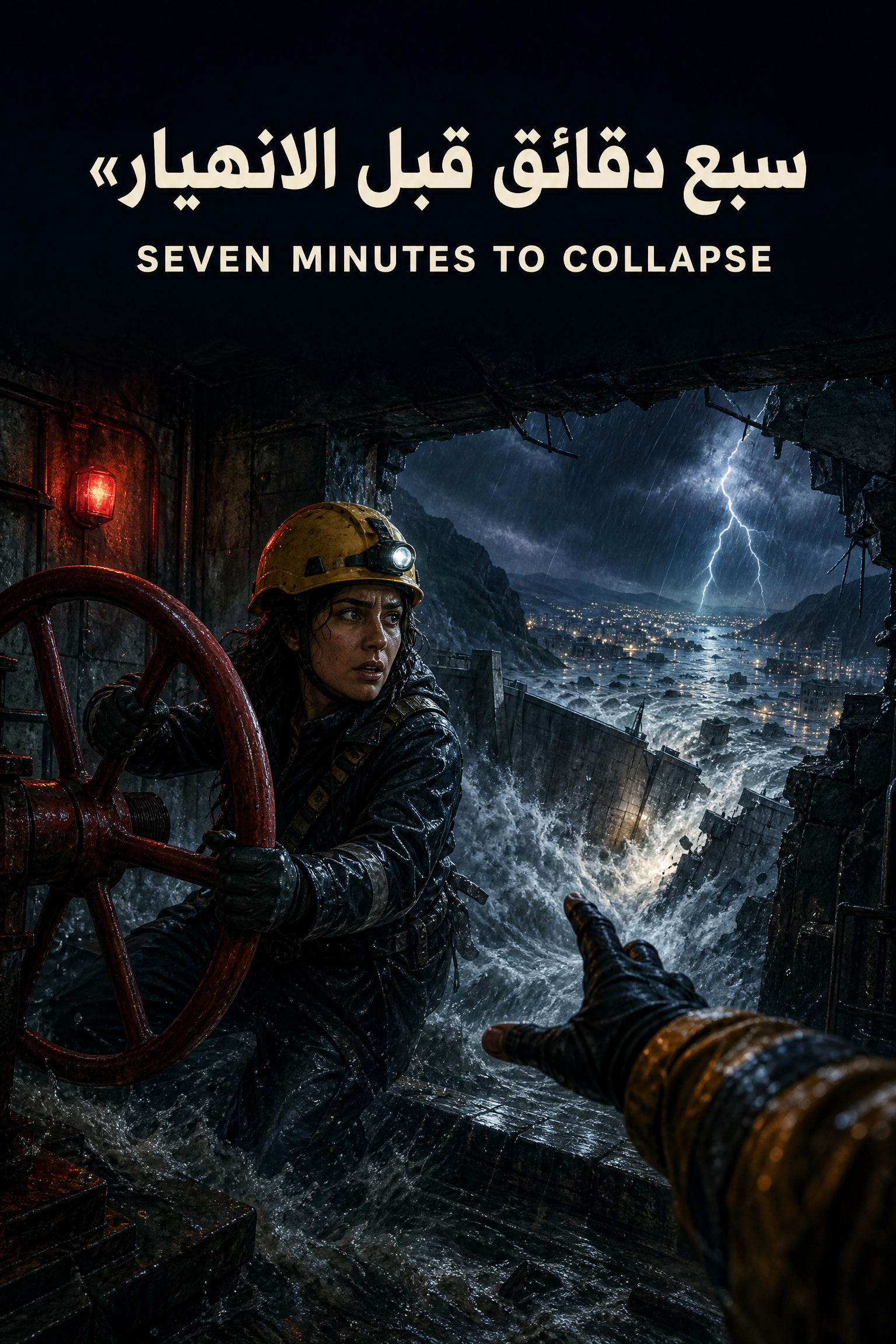
Chapter One: The Warning That Should Never Have Arrived
At 2:17 a.m., Rawan’s phone vibrated twice on the kitchen table.
The vibration wasn’t what woke her. The water did.
Outside, rain poured down the mountainsides as if the sky had finally opened a door it had kept shut for years. Below, Wadi City glimmered beneath the storm—its streets winding between hills, its narrow river cutting from the northern edge toward the old dam.
A red warning flashed across her screen:
Drain Gate Three failure — collapse risk in seven minutes.
Rawan read it once, then again. The warning system sent an alert like this only when every backup sensor had gone offline. Then the caller ID appeared.
Emergency Response Center — Central Metro Station.
“Rawan, can you hear me?” Her brother Yazan’s voice crackled through the phone. “Water’s in the tunnel. We’re beneath the station… the east gate won’t respond.”
“How many of you?”
“Two rescue teams. Thirteen civilians. There are children.”
The line broke, then returned with the scrape of metal and a heavy impact.
“Yazan! Get everyone to the west passage now. Don’t wait for the lift.”
“The west route collapsed. Rawan, the dam—”
Then the connection died.
Rawan was the structural engineer who had designed the dam’s new drainage system before resigning after a public dispute with Atlas, the company contracted to build it. Atlas called her concerns exaggerated. Rawan said they had covered a crack in the wall with a layer of cement and paint, then signed a safety certificate.
She hadn’t expected the storm to prove who was right.
She pulled on her jacket and grabbed her helmet and the maintenance-truck keys. Before she could leave, the phone rang again. An unknown number.
“Don’t go to the dam,” a calm voice said. “The northern road is cut. Wait for the rescue crews.”
She knew the voice. Engineer Fouad al-Kilani, Atlas project director—the man who had signed the safety certificate.
“Yazan is at the station.”
“You can’t reach him.”
“I’m not asking permission.”
Fouad paused, then said, “If you open Gate Four, the old district will drown.”
Her hand stopped on the doorknob.
“I didn’t say I was opening any gate.”
He hung up.
Only then did she understand. Fouad wasn’t trying to keep her safe. He knew what she would find at the dam.
Chapter Two: The Road That Was Falling Away
The maintenance truck fought its way up the mountain road. Rain battered the windshield; the wipers moved as if they were trying to shove back an entire sea. Ahead, red warning lights blinked at the cliffside bend. Rawan stopped, rolled down her window, and looked out.
A mass of mud and rock slid across the road, and part of it fell into the valley. Only a narrow strip remained against the retaining wall, barely wide enough for the truck.
She put both hands on the steering wheel.
Seven minutes, she told herself.
At the top of the bend, headlights appeared. A black car. Not a rescue vehicle. Rawan turned off the truck’s lights and let the rain hide her. The car passed slowly, then stopped. Two men climbed out wearing Atlas safety jackets. They carried no rescue tools; one had a radio, the other a long case.
Rawan climbed out on the passenger side and crouched behind the road’s edge. She heard one man say:
“The director wants the records gone before the police arrive.”
This wasn’t about cracks in the concrete anymore. There were hidden records in the control room—and perhaps worse.
She moved around the back of the truck and pulled out an emergency flare launcher. She aimed down the slope and fired. The sky flashed red. The two men turned toward the valley. Rawan raced to the driver’s seat and started the engine.
One man chased her. A bullet struck the side mirror. She didn’t look back. At the next bend, she hit the brakes and wrenched the wheel. The maintenance truck skidded across the muddy strip and slammed into the Atlas car. Both spun on the gravel, leaving the company vehicle jammed between the barrier and the rock face.
Rawan didn’t stop to check. Red lights on the dashboard were counting down, and every second brought the city closer to the water.
Chapter Three: The City Beneath the Surface
When she reached the dam plaza, she found the main gate open. There were no guards, no crew—only alarms screaming into the rain and brown water pouring from a side channel toward the low-lying neighborhoods.
She ran into the control room. The door hung ajar, and wet bootprints marked the floor. The screens showed a map of the city. Drain Gate Three was jammed halfway closed. Gate Four, however, was fully open, directing the flood toward the old district and the metro station.
This wasn’t a malfunction. Someone had diverted the flood.
The control unit had been disconnected from the emergency network, its wires carefully cut. A single printout remained on the desk: an internal report signed by Fouad. She read the first line and understood what he had been trying to bury. Months earlier, his team had found cracks in the new diversion tunnel. If the truth surfaced, Atlas would be exposed for reducing the wall’s thickness and cutting construction costs at the dam’s expense.
But why direct the flood toward the district?
The door opened behind her.
Fouad entered, holding a small handgun. His coat was almost dry, which felt like an insult all by itself.
“Give me the report,” he said.
“People are in the metro.”
“If the diversion tunnel collapses, water will reach the city center. Sending it through the old district relieves pressure.”
“The old district has thousands of residents.”
“They received the evacuation warning.”
Rawan looked at the screen. No alert had been sent. Fouad wasn’t saving the city; he was choosing which part could be sacrificed so the dam—and his record—might survive.
“The signal never reached them,” she said. “You cut the network.”
He raised the gun slightly.
“Open Channel Four all the way. Then I’ll clear your route to the station.”
Rawan knew he was lying. She also knew that every second spent arguing sent more water into the tunnel.
She set the report on the desk.
“Help me close Four.”
“I won’t let the dam collapse.”
“The dam is collapsing because you built it on a lie.”
Fouad moved toward the control panel. At the same instant, Rawan hit the manual alarm switch. The screens went dark for a second. She lunged; her shoulder slammed into his arm. The gun slid across the floor. Fouad drove her toward the wall, but she twisted away and ripped his access card from his hand.
It wasn’t a graceful fight. It was furniture, short breaths, and hands searching for something to grab. Fouad struck her with an elbow, and the side of her head hit a cabinet. She shoved him into the exposed wiring panel. Blue sparks snapped, and the control unit disconnected from the main power.
The alarms changed pitch. There were no longer seven minutes.
There were three.
Chapter Four: Underwater
Rawan couldn’t close the gate from the control room. The emergency mechanism was manual, in a maintenance chamber below the river level. To reach it, she had to cross a service passage already filling with water.
She ran down the stairs. At the bottom, she found Yazan standing on a metal platform with a little girl hoisted over his shoulder. Behind him were the rescue team and eight other people. Two were injured. The water was up to their chests.
“I thought you weren’t coming,” Yazan said.
“And I thought you knew when to stop trying to save everyone alone.”
“I learned from you.”
There was no time to hug. She pointed to the eastern passage.
“Take them to the west stairwell. Don’t go down to the platform. The water is coming through Channel Four.”
“And the gate?”
“I’ll close it manually.”
“You’re not doing that alone.”
“I didn’t say I was.”
At the end of the passage was a red metal wheel connected to the gate by a massive chain. Rawan needed four full turns to start lowering the gate. But water hammered the lock from the other side, and each turn took the strength of two people.
Yazan left the girl with a paramedic and joined her. They pushed together. The wheel moved an inch, then stopped.
A tremendous impact shook the tunnel overhead. Concrete fragments fell. One of the women screamed.
“The ceiling won’t hold!” Yazan shouted.
“If we leave it open, no one will.”
Fouad came up behind them, one arm injured. He carried no weapon.
“There’s a faster way,” he said. “The chain is jammed at the joint. It has to be released from inside the chamber.”
“And the water?”
“It will fill the chamber in a minute.”
Yazan looked at Rawan. They both understood: whoever went in might not get out easily.
Fouad pulled an old key from his pocket and handed it to her.
“I signed the report. I’ll fix what I broke.”
“If you go in, you may not come back.”
“I know.”
That wasn’t enough to forgive him. But it was enough to show he wasn’t running this time.
Fouad entered the chamber. Rawan and Yazan lifted the wheel with everything they had left. The chain moved, then locked. From behind the door, they heard Fouad pounding on the metal.
“The joint!” he shouted. “Pull now!”
They pushed. The wheel didn’t move.
“Again!” Yazan yelled.
They planted their feet against the base and hauled with all their strength. This time, the chain moved. One turn. Then another. The gate’s rumble rose from deep inside the dam, like a beast waking up.
But water burst through a crack beneath the door and began filling the chamber where Fouad was trapped.
Rawan shouted his name.
“Keep going!” his voice came from inside.
It wasn’t a request. It was an order.
Chapter Five: The Choice
The gate reached halfway down. Then a pressure pipe burst behind the wall. A wave threw Yazan to the floor and knocked Rawan to her knees. The wheel slipped free, and the chain began to loosen.
If it slackened all the way, the gate would rise again.
Yazan ran to his sister and dragged her clear of the current. A wound on his arm was bleeding, but he got to his feet.
“Get the others out. I’ll hold it.”
“No.”
“Rawan, we’re out of time.”
He grabbed the wheel alone. It wouldn’t budge. Behind the door, Fouad had gone silent.
Rawan thought of her father. Twenty years earlier, he had died in an old drainage tunnel trying to close a gate that jammed in a flood. She had spent years hating the dam, then more years trying to build one that wouldn’t repeat his mistake. Now she was about to let her brother die the same way so she could save everyone else.
But she wasn’t a child waiting for someone to come back from the water anymore.
She pulled a steel tow cable from her kit, wrapped it around the wheel, and anchored its end to a solid base. She signaled Yazan. He climbed into the small maintenance vehicle the station crew had left behind while she secured the cable.
“On my count,” she said.
“One… two… three!”
The vehicle reversed. The cable pulled the wheel, and the gate began to move again. The vehicle tipped onto its side, but the lock turned a full rotation. Then another.
Suddenly, the chamber door flew open. Water surged into the passage, and Fouad appeared, clinging to the chain with both hands. His jacket was torn, his face pale. He let go at the last second. The current slammed him against the doorway and carried him toward the opening.
Yazan leapt and caught his wrist. Rawan grabbed Yazan by the belt. The three of them pulled until they crashed into the wall. Fouad was alive, but he had nothing left to hide behind.
The gate settled into place. The water level dropped a little. Then the alarms stopped all at once.
A heavy silence filled the passage, broken by the little girl crying on the stairs.
Chapter Six: After the Water
The survivors reached the surface with the first light of dawn. It wasn’t a beautiful dawn; it only revealed what the storm had done. Cars lay overturned in the streets, windows were shattered, and the dam plaza was covered in mud. But the old district hadn’t been completely flooded. Rescue crews reached the station and pulled the last trapped people out of the tunnel before the water rose again.
An officer approached Fouad. He didn’t resist when they put him in handcuffs. Before they led him away, he looked at Rawan.
“I kept telling myself I was protecting the project,” he said.
“You were protecting your signature.”
He had no answer.
Yazan sat on the edge of an ambulance, his arm wrapped in a bandage. Rawan sat beside him and stared at the dam. It wasn’t a hero. It was concrete, steel, and cracks that paint could no longer hide.
“Is it over?” Yazan asked.
She shook her head.
“No. Now the investigation begins. Then repairs. Then questions nobody will like.”
“You sound excited.”
“I’m too tired to be afraid.”
A final message appeared on her phone from the city system:
Connection restored. All alerts recorded.
Rawan looked toward the mountains. The storm was moving away, but water remained everywhere—in the roads, the tunnels, and their memories.
For the first time, she didn’t think of her father as the man who never came back. She thought of him as the man who taught her that rescue isn’t about entering the water without fear. It’s about knowing why you went in—and who must come out with you.
Light fell across the soaked city.
Seven minutes had been enough to drown it.