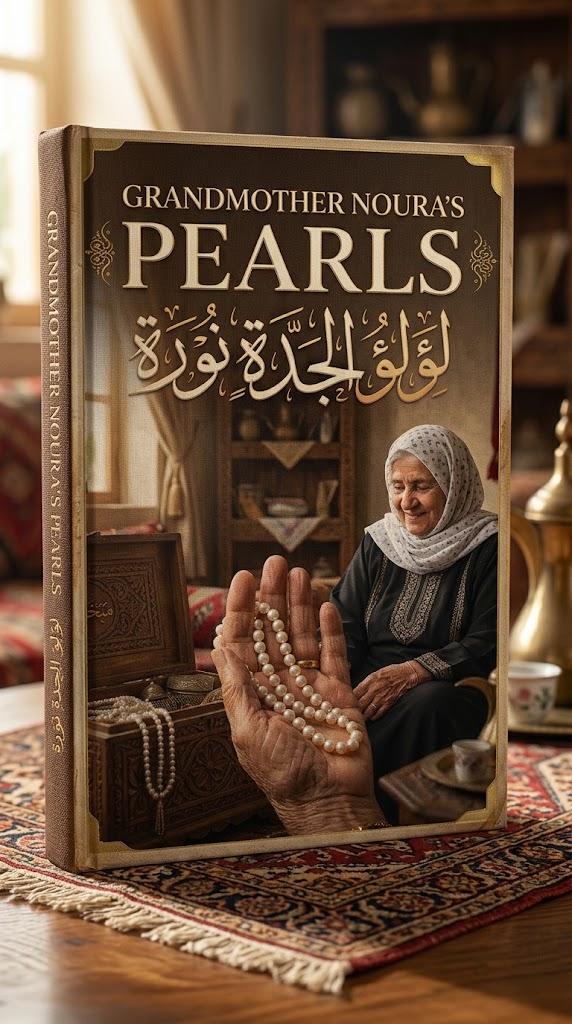
1. The Blue Biscuit Tin
In Grandmother Noura's house in Al-Balad, Jeddah, everything was old except the hearts. A house of coral stone with dark wooden lattice windows, drifting with the scent of oud, cardamom, and rosewater, and in its upper room an ancient wardrobe that no one opened but her. And on top of the wardrobe, since before Mariam was born, sat a blue tin biscuit box with a faded picture of a sailing ship, where the grandmother kept the most precious thing she owned.
"My pearls," she used to say, in the voice of someone speaking of a son abroad. "Your grandfather brought them from Bahrain when I was twenty. They go to whomever your hearts love most."
It was three days before Mariam's engagement to Omar. Eid had arrived, and the house was crammed with sons, grandchildren, neighbors, coffee, and ma'moul. After the afternoon prayer, Grandmother called Mariam to the upper room, closed the door behind them, and opened the tin with slightly trembling hands.
The pearls were there, wrapped in a piece of velvet. Rows of white pearls tinged with the pink of twilight, smooth, perfectly matched, glowing as if lit from within. Mariam gazed at them and whispered: "How beautiful, Grandma."
But her grandmother's face did not smile.
2. A Pearl Against the Teeth
Grandmother lifted the necklace, brought one pearl to her mouth, and rubbed it gently against her front teeth. She shook her head slowly and put it back. Then she lifted the second, and the third, her lips pressing tighter each time.
"A real pearl, Mariam," she said in a low voice, "has a slight grittiness when you touch it to your teeth, like tiny grains of sand. That's what my father taught me, and he was a pearl merchant. But this…" and she held the necklace out to her granddaughter, "this one is smooth as glass."
Mariam tried it herself, and felt the difference the way you feel the difference between your mother's hand and a stranger's. There was no doubt. The necklace was lovely, skillfully made, but fake.
"When did you find out?" she asked, barely audible.
"Eight years ago. At an Eid like this one." Grandmother sighed. "I told no one. I waited. I thought someone would bring it back, feel ashamed and put it where it belonged. But the years passed and no one did."
"And why are you telling me now?"
"Because you're getting engaged on Friday. Because I'm eighty and I don't want to die knowing the truth alone. And because you, my girl, are the only one in this house who knows how to ask without wounding."
3. Three Names
Grandmother hadn't asked her to investigate. But Mariam, a journalist at a local newspaper, knew how questions turn into threads. That night she sat on the roof of the house, the stars so close they might have been real pearls, and wrote three names in her notebook.
Khalid. Her eldest uncle, a man with a loud voice, a generous laugh, and debts no one knew the size of. Grandmother had always been colder with him than with the rest, avoided his eyes in gatherings, and said that "whoever loves money more than his family can't be trusted with anything."
Faisal. Her grandmother's nephew, a man of thirty with a weakness for expensive cars, who visited Grandmother often and sat with her for long stretches. Perhaps too long.
Hessa. Her youngest aunt. A quiet widow of fifty-eight who never raised her voice, who served everyone at Eid and vanished when the talk began. It occurred to no one to suspect her.
Khalid was the obvious answer. And Mariam hated obvious answers.
4. A Receipt in a Coat Pocket
The next morning, while Khalid was laughing in the courtyard with the children, Mariam slipped into the guest room where his gray coat hung. She took a breath, then reached into the inside pocket.
She found a folded slip: a pawn receipt from a shop on Qabil Street. A piece, a sum, and a date from this very week.
Her heart pounded. But something in the paper made her slow down: the receipt read "wristwatch, Swiss make." It was neither pearls nor gold.
That evening, helping him carry a tray of tea out to the guests, she whispered: "Uncle, why did you pawn your watch?"
Khalid froze. Then he let out a short, joyless laugh. "Who told you? You're just like your grandmother. You look without asking." And he added, quietly: "Please keep it between us. I'm still paying off an old loan I don't want anyone to know about. Don't see in me what everyone else sees. I've sold everything I had because I don't want to put out my hand to my mother's house."
There was a sincerity in his voice that can't be invented. Mariam realized she no longer suspected him.
5. The Gold Market
The next morning, Mariam unclasped the necklace and turned the beads over under the window light. On a corner of the delicate clasp, almost invisible, she found a small mark engraved with care: "A.Z."
She asked about it in the Al-Balad gold market, among the cramped shops crowded with bracelets and rings. After three shops, a boy chewing gum told her: "That's Abu Zaid's stamp. His shop is at the end of the lane. But he's old now, and only sits in the mornings."
Abu Zaid was seventy, in a white turban and thick glasses, sitting behind a small wooden table. He examined the necklace through his loupe, then raised soft eyes to her: "My piece. I made it."
"When?"
"Nine years ago, in the spring. A woman came to me in a black abaya with reddened eyes. She said her husband was ill in his kidneys and needed an operation in Germany, and that she had pearls that would be worth nothing to her if her husband died. She sold me the real ones and asked me to make an exact copy that no one could tell apart. It took me three weeks to find pearls that came close."
"Do you remember her name?"
"I wrote it in my ledger, when she asked me to hold the original pearls and not sell them for a year, in case she could buy them back." He opened a yellowed notebook and turned its pages with a trembling finger. "Hessa. H. A." Then he added, in a plaintive tone: "She couldn't redeem them. In the end I sold them to a dealer in Dubai. But she still comes every Ramadan and puts an envelope in my hand, saying: this is a payment toward what I'll buy one day. She's gathered a hundred and forty thousand so far, out of two hundred."
Mariam closed her fingers around the necklace. The smooth pearls felt heavy now, like a heart.
6. Aunt Hessa
She found her in the kitchen before sunset, peeling eggplants with a practiced hand and a heavy silence. No one else was there. Mariam laid the necklace on the table.
Hessa said nothing. Then she slowly wiped her hands on her apron, sat on a small chair, and stared at the floor.
"I knew this day would come," she said, in a voice dry as old paper. "On the day I took the pearls, Abdullah was lying in intensive care and no one knew if he'd wake. I wasn't thinking. I only wanted him to live. And he lived two more years. Then he died."
She wept without sound, the way women weep who have learned that tears are only for when they're alone.
"Nine years I've been counting the days. I saved from my sewing, from my pension, from everything I could. I thought I'd return it before Mother opened the tin. But I was slower than I should have been."
"And Khalid?" Mariam asked gently. "Grandma thought he…"
Hessa lifted her head sharply. "Khalid?" Then she covered her mouth with her hand. "God. Did Mother think it was him? All these years?"
7. What Grandmother Knew
On Friday evening, at the engagement party, the upper room filled with faces, lights, and gifts. Before the sweets were served, Grandmother Noura called for silence with her wooden cane.
"I will give the pearls to Mariam, as I promised." Then she looked at the guests, one by one, slowly. "But first, someone has something to say."
Hessa stood. Her hands trembled, but her voice came out steady. She told them everything, without adornment or apology, only the truth as it was. When she finished, a silence fell that not even the children's breathing broke.
Then Grandmother turned toward her eldest son, who sat in the corner looking at his hands. "Khalid."
He raised his head.
"I wronged you for eight years. I thought it was you. Even when I learned it wasn't, I didn't know how to apologize." And she stretched out her veined hand to him. "Come here."
Khalid came forward with slow steps and bent to kiss his mother's hand, and no one looked at his face, because everyone was crying.
Then Grandmother took the counterfeit necklace and placed it around Mariam's neck, and said in her quiet voice: "These are not my pearls. But they're the most precious thing I own today, because they carry a true story." Then she looked at Hessa: "And the real ones, we'll buy back together, I and all of you. Pearls can be bought, my daughter. But my daughters cannot be bought."
That evening, in the upper room of Grandmother Noura's house, each member of the family put an envelope into the blue biscuit tin. The last was Khalid, who put in his pawn receipt.