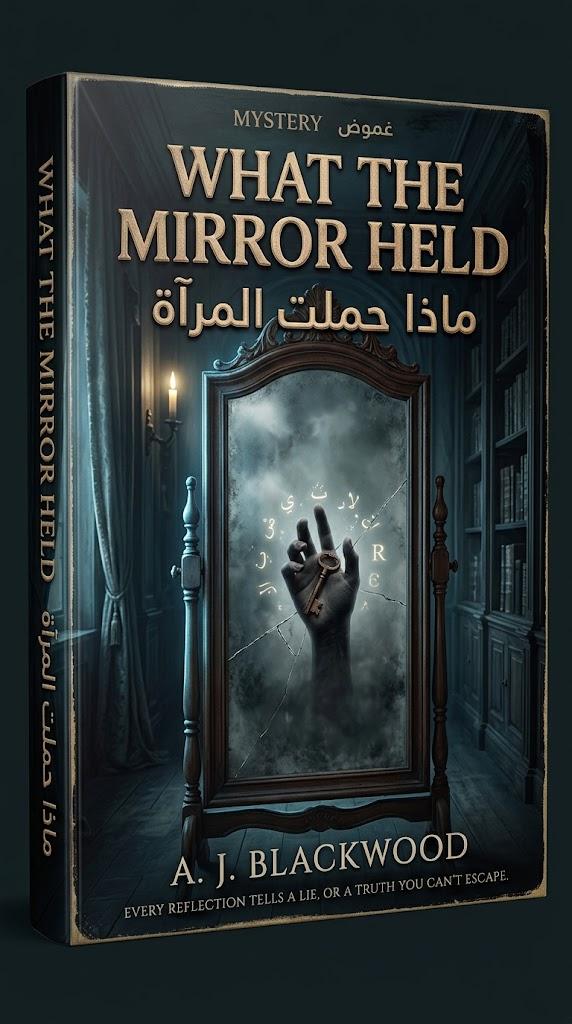
1. The Damaged Photograph
Rania Haddad's studio occupied the ground floor of an old building in Jabal al-Weibdeh, in Amman: one room with a high ceiling and a window overlooking a flight of stone steps, smelling of old paper and solvents. The walls were hung with portraits of people who had gone, whose faces Rania had returned to them with a soft brush, a computer program, and endless patience. She told her clients: "I don't remake the past. I only remove whatever has been hiding it from you."
On a damp autumn morning, a young man of twenty-seven came in, tired-eyed, holding a brown envelope in both hands as if it were a wounded bird. He said his name was Tariq Nasser, that his mother Salwa had died a week ago, and that he needed her wedding photograph before the memorial on Friday.
Rania drew the photograph out with her fingertips. It was a color print, twenty by twenty-five centimeters, dated 1998. A bride in a dress with puffed sleeves, a slender groom smiling the smile of a man who couldn't yet believe his luck. But water had eaten half of it: a round brown stain had crept up from the lower corner and swallowed part of the dress, and beneath it ran jagged white lines where the surface had cracked.
"The important part is intact," she said, turning it over. "The two faces. That can be fixed. But the background needs work."
"The background doesn't matter," said Tariq. "I only want my mother's and father's faces."
But Rania had never known how to do half a job. And that was how it all began.
2. What Lay Deep in the Glass
She scanned the print at twelve hundred dots per inch and opened it on the large screen. At night, when the lane had fallen silent, she began to enlarge it piece by piece, the way a surgeon does.
Behind the couple, on the wall, hung a gilt-framed mirror reflecting the entire hall. At first Rania didn't notice it; it was clouded with the water's haze. But when she raised the contrast and cleared the gray film, the hall began to take shape in the little glass: round tables, white flowers, guests laughing.
Then she saw the man.
He sat at the table near the door, in a gray suit with his hair combed back, a small dark mole at the corner of his left eyebrow. He was raising a glass in his left hand and laughing at another man beside him, of whom only a shoulder and a finger were visible: a finger on which gleamed a gold ring set with a green stone.
Rania sent Tariq a short message with the enlarged piece of the mirror attached. His reply came minutes later, brief and strange: "Who is that?"
"I was about to ask you."
An hour later her phone rang. Tariq's voice was hoarse. "That's my uncle Jamil. My father's brother. But he… wasn't there. He didn't attend the wedding. He left for Canada three weeks before it, and sent a telegram of congratulations. My father always said he never forgave us for not leaving with him."
"Maybe he came back at the last minute?"
"No." Tariq said it sharply, then lowered his voice. "No. You know what's odd? There isn't a single picture of him in our house. Our albums are empty of him, as though he'd never been born. When I asked my mother about him, at fifteen, she gave me that look, the one I knew was followed by a long silence."
3. The Uncle Who Wasn't There
Rania didn't sleep. She knew photographs don't lie, but people lie around them, and sometimes they deliberately erase an entire person from a story. If the man in the mirror was Jamil, then the whole family had been lying about him, and to Tariq, for twenty-eight years.
The next day Tariq came to the studio, sat across from her, and set a cardboard box on the table. "I found it in my father's closet. I'd never opened it. I didn't dare."
Inside were dozens of letters and commercial papers. On top lay a sheet printed with the letterhead of Al-Nahda Press, the company of his father Nabil and his partner Elias Qasim. At the bottom were two signatures: his father's, and another, Jamil Nasser's, slightly different in the slant of its letters.
Rania held the paper under her loupe. "This second signature is forged," she said quietly. "See where the pen lifts in the middle of the last letter? Someone signing naturally wouldn't lift there."
Tariq raised his eyes. "Elias Qasim… he's the man with the green ring. He always wore it. Even at the funeral."
4. What Was Written in Pencil
One thing remained that Rania hadn't done: turn the photograph over. On its back the water stain had consumed everything, and the paper looked yellowed and lifeless. But Rania owned an infrared scanner, which she used to reveal what time had erased.
She laid the photograph under the dim light and waited. Then a thin line began to appear: a woman's hand, in pencil, the kind of writing left for eyes that know where to look:
"To Jamil: because you were here, though no one saw you. Forgive us. Salwa."
Tariq was silent for a long time. Then he said, in a voice barely audible: "She meant to send it to him. She wrote to him and never posted it."
"And she asked you to restore the photograph for the memorial," said Rania. "But she didn't want you to see the faces. She wanted you to see the mirror."
5. Al-Nahda Press
Tariq took the box to the press the following day. Elias Qasim, now a man of seventy-two, sat behind an enormous wooden desk with the green ring still on his finger. He greeted him with a welcoming smile, which vanished when he saw the stamped paper.
"Where did you get this?"
"From my father's closet. And my parents' wedding photograph, where my uncle Jamil is sitting at your table."
Elias said nothing. He leaned back in his chair and looked out the window, then said in a broken voice: "Your father was weaker than you think, my boy. And Jamil was stronger than he should have been. He found out I'd borrowed in the press's name and forged his signature. He said he'd go to the bank in the morning. We went to your father the night before the wedding and asked him to choose."
"And what did he choose?"
"He chose not to lose the press. Or the wedding. Or his peace." Elias smiled a bitter smile. "He asked Jamil to leave, gave him a ticket and some money. Jamil came to the wedding in secret to see his brother one last time, then flew out that same night. And we told people he'd left before. I never killed anyone. But I took a man's life from him."
6. A Mother's Last Words
Tariq sat in his car in front of the press for a long while, then returned to the studio. He placed in front of Rania an envelope she hadn't seen before, found under his mother's pillow at the hospital, with trembling handwriting on it: "For Tariq, after you've seen the photograph."
They opened it together. It was a single sheet:
"My son, I knew everything and never dared. I couldn't tell you the truth with my own tongue, so I let it tell itself. Ask someone who knows how to look to restore the photograph. The truth is always in the glass, not in the faces. And if Jamil is still alive, tell him that Salwa never forgot him."
Tariq bowed his head and said nothing. Rania had known for a long time that some clients don't come to have their photographs restored, but to have something in themselves restored.
7. A Call to Montreal
They found the address on an old greeting card at the bottom of the box, with a Canadian stamp and an address in Montreal, written in the hand of a man who had never lost hope of being answered. Tariq searched for the number for five days. On the sixth evening, standing on the studio balcony while rain whispered on the stones, he pressed the buttons.
The phone rang three times. Then came an old man's voice, deep, speaking with a weary accent: "Hello?"
Tariq hesitated. Then he said: "Uncle Jamil? It's Tariq. Nabil and Salwa's son."
A long silence on the line. Then Rania, from her place behind the door, heard a sound like laughter and weeping together. "My God… Salwa's boy! You've grown! Do you see?" And then, after a moment, with the eagerness of a man who had waited twenty-eight years: "Does your mother still keep the wedding photograph?"
Tariq lifted his eyes to Rania and smiled a smile wet with tears. The photograph, restored now, lay on the table, and in its small mirror a man with a mole above his left eyebrow raised his glass to everyone, and laughed.